
Identification of borophene allotropes from STM images by Machine Learning: from the development of a neural network interatomic potential to building the image classification tool.
February 2024 → July 2024 (Master2)
🧪🔬🖥️ Institut de Lumière Matère (ILM) , team: Theoretical Physical Chemistry
🧪🔬🖥️ Laboratory des Matériaux et Interfaces (LMI) , team: Matériaux à Basse Dimensionnalité (MBD)
📑 Thesis
More details
Borophene is a 2D material that has honeycomb structures similar to graphene. Borophene exists in various structures called allotropes. Furthermore, to characterize such materials, a Scanning Tunneling Microscope (STM) is generally used. However, the process is not straightforward and involves comparing experimental data to theoretically simulated images generated from Density Functional Theory (DFT). Although DFT is accurate, it is time-consuming. The intended purpose is to utilize an existing Neural Network Potential (NNP) to create a database of structures and simulated STM images for training and testing a classification neural network.
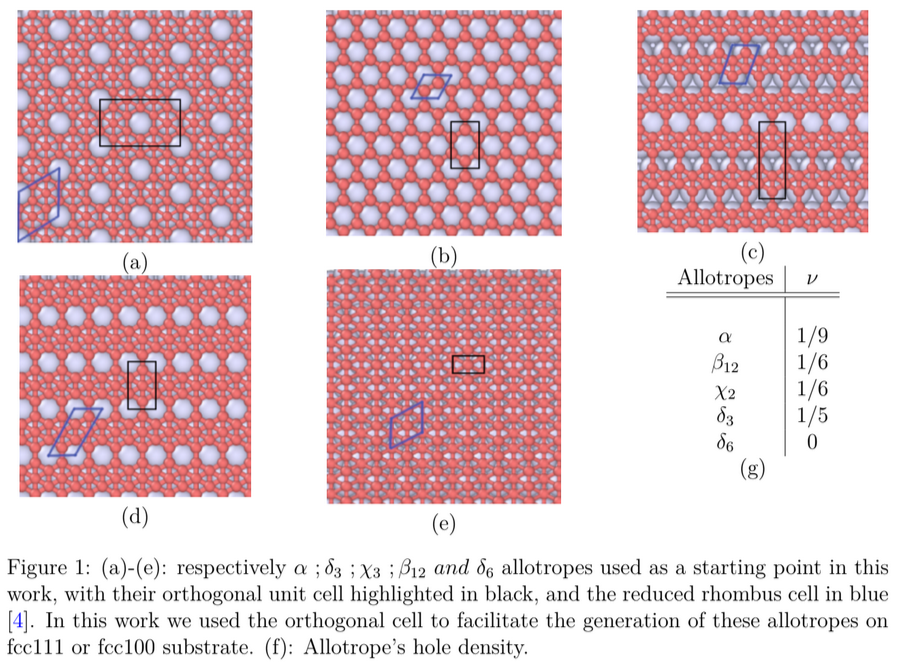 Borophene Allotropes | 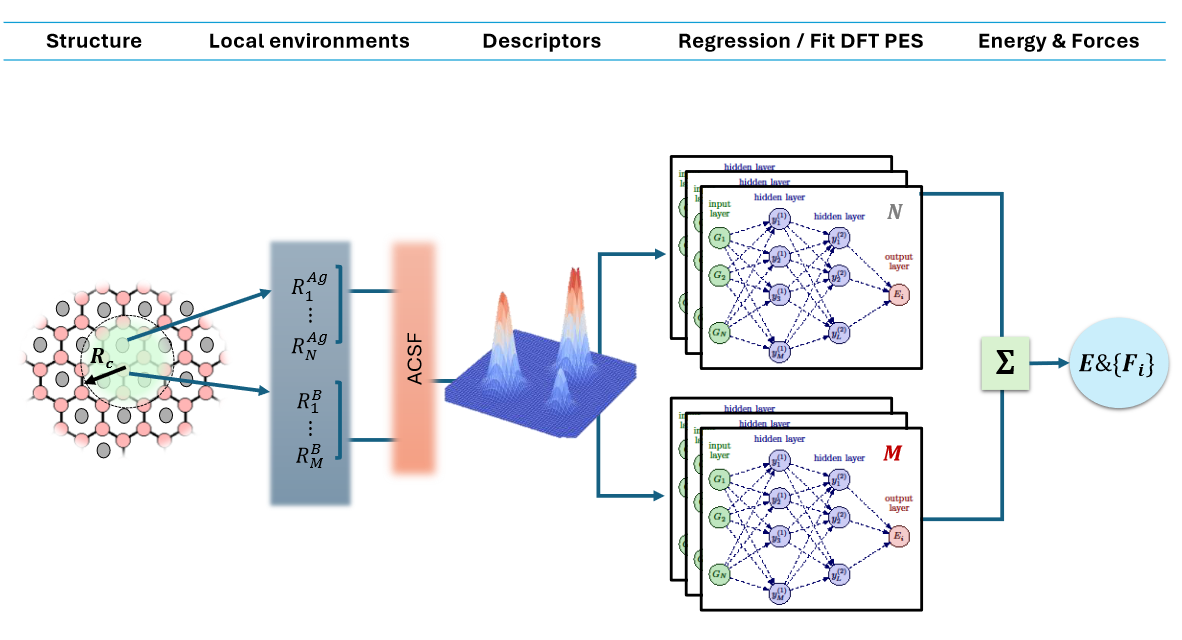 High dimensional neural network architecture | 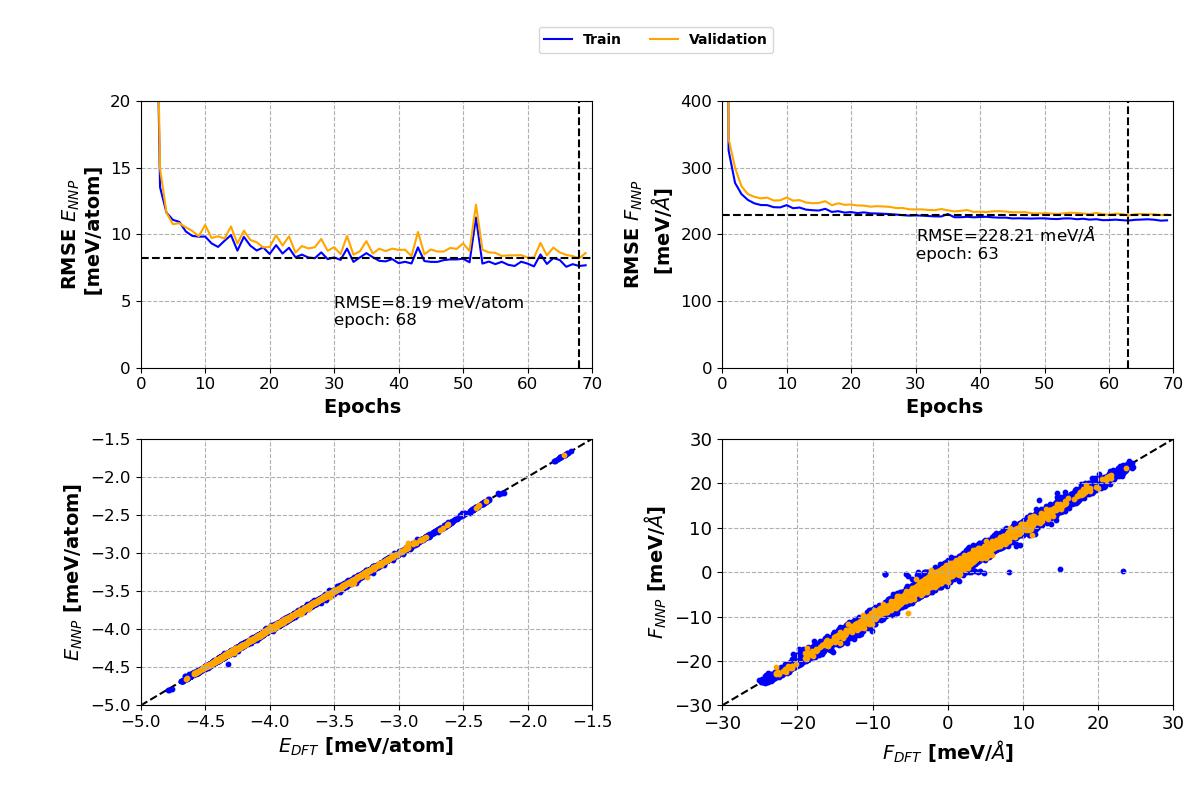 Energies & Forces-normes validations |
Characterization Of Ultrashort Laser Pulse Centred at 800 nm
February 2023 → June 2023 (Master2)
🧪🔬🖥️ Institut de physique et chimie des Matériaux de Strasbourg (IPCMS) , department: Ultrafast Optics and Nanophotonics (DON)
📑 Thesis
More details
In order to study the kinetics of molecules and probe their optical properties, we employ spectroscopy, which enables us to perform transient absorption and observe the signatures of rapid photo-reactions (e.g., carbon-carbon double bond isomerization) occurring on picosecond or sub-picosecond timescales. However, achieving this requires a well-characterized laser pulse, which means full access to temporal and spectral profiles. Unfortunately, electronic measurement does not accommodate the rapid oscillation of the electric field (few cycles). Here, we call for indirect optical characterization, such as using Frequency Resolved Optical Gating (FROG). For this work, we deployed Time Domain Ptychography techniques to solve a reconstruction problem, in particular, spectral phase retrieval. I implemented the Time Domain Ptychography algorithm to characterize the ultrashort pulses.
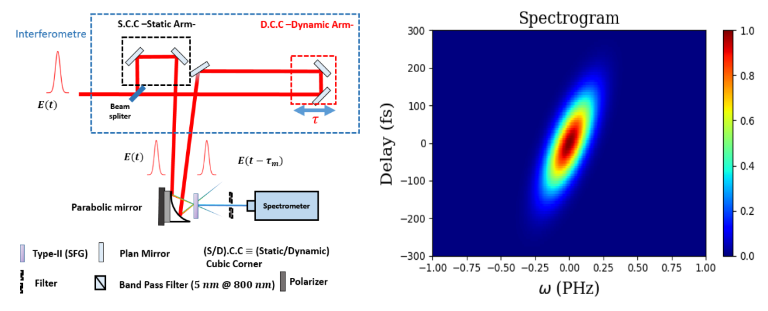 Frequency Resolved Optical Gating (FROG) | 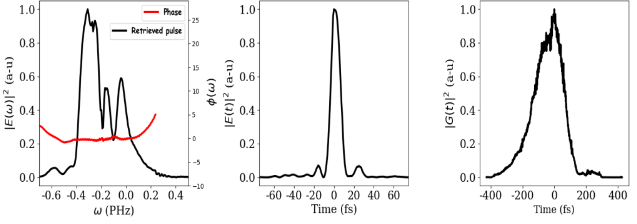 Retrievement of the pulse profile/phase. | 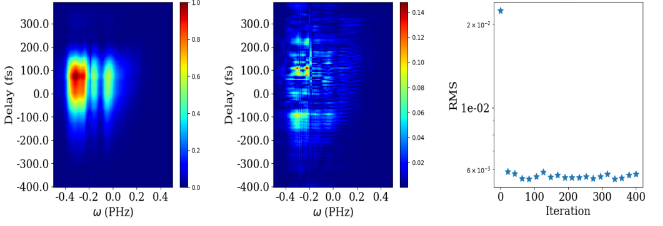 The retrieved 2D FROG map difference between measured & reconstructed spectra. |
Power Loss Analysis On Based Silicon Solar cells
March 2021 → June 2021 (Master2)
🧪🔬🖥️ Research Center for Semiconductor Technology and Energetics (CRTSE) Division: Semiconductor Conversion Device Development
📑 Absract
More details
In order to study the kinetics of molecules and probe their optical properties, we employ spectroscopy, which enables us to perform transient absorption and observe the signatures of rapid photo-reactions (e.g., carbon-carbon double bond isomerization) occurring on picosecond or sub-picosecond timescales. However, achieving this requires a well-characterized laser pulse, which means full access to temporal and spectral profiles. Unfortunately, electronic measurement does not accommodate the rapid oscillation of the electric field (few cycles). Here, we call for indirect optical characterization, such as using Frequency Resolved Optical Gating (FROG). For this work, we deployed Time Domain Ptychography techniques to solve a reconstruction problem, in particular, spectral phase retrieval. I implemented the Time Domain Ptychography algorithm to characterize the ultrashort pulses.
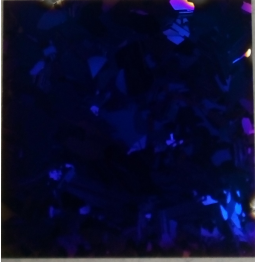 Manufactured m-Si solar cell (before screen printing) | 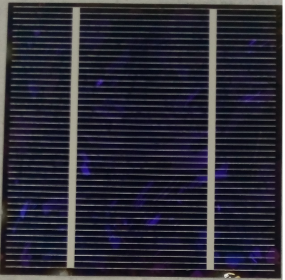 Manufactured m-Si solar cell (after screen printing) with Al leads (contacts) | 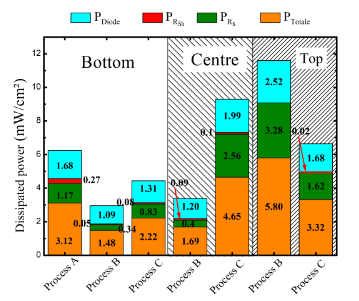 Dissipated Power in the shunt, the series resistance and in the forward bias diode. | Current Analysis of losses due to reflection and parasitic absorption. |